Open vs Closed Position in Salsa: Differences and How to Transition Between Them
Part of: Leading and Following in Bachata: The Complete Guide
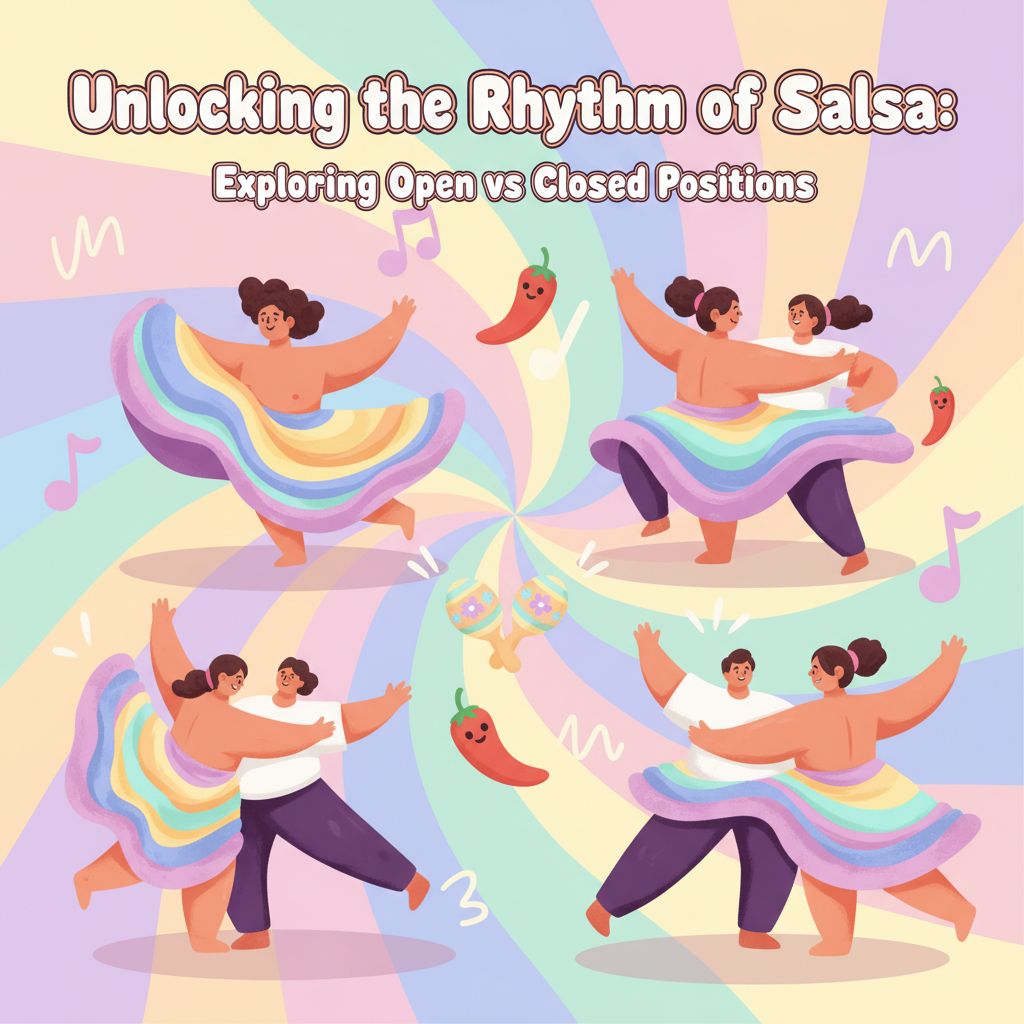
In salsa, open position means the partners face each other connected only through one or both hands, with space between their bodies. Closed position means the lead’s right hand is on the follower’s back, the follower’s left hand is on the lead’s shoulder or upper arm, and the other two hands are joined. Open position is where most turn patterns happen; closed position is for close, compact partnering.
Both positions rely on the same connection skills: a toned frame, plus tension and compression through the arms. Those skills are explained step by step in our complete guide to leading and following in bachata, and they carry over to salsa almost unchanged.
What is open position in salsa?
Open position is a position in which partners are connected mainly at the hands, and the connection depends heavily on frame and on the compression and tension in both partners’ arms (Wikipedia: Open position). In salsa you’ll meet it as:
- Two-hand hold: both hands connected, usually at about waist height, palms lightly hooked rather than gripped.
- One-hand hold: lead’s left hand with the follower’s right hand (or cross-hand, right to right), which leaves a free arm for styling.
- Breaks with no contact: shines and free spins, where each dancer moves on their own for a few bars.
Open position gives both dancers room. That is why it is where cross-body leads, inside and outside turns, hand changes and most of the patterns in salsa turn patterns and partnerwork happen. It is also where beginners usually start, because each dancer can focus on their own basic step.
What is closed position in salsa?
Closed position covers positions in which the partners hold each other while facing roughly toward each other (Wikipedia: Closed position). In salsa that usually means:
- Lead’s right hand on the follower’s back, around the left shoulder blade. Not the waist and not the lower back.
- Follower’s left hand resting on the lead’s right shoulder or upper arm.
- Lead’s left hand and follower’s right hand joined at roughly shoulder height, with the elbows in front of the body.
- Distance: close but not chest to chest. There should be enough room for both people to step forward and back.
Closed position is common at the start of a dance, during the basic step, for compact moves on a crowded floor, and in calmer parts of the music. Many dancers like to use it to “reset” after a run of turns. In Cuban-style salsa (casino), closed position and circular movement are used a lot. Linear styles (often called LA or New York style) tend to spend more time in open position along the slot.
Open vs closed position at a glance
| Open position | Closed position | |
|---|---|---|
| Connection | One or two hands | Hand on back, hand on shoulder, one joined hand |
| Space between partners | Arm’s length or more | Close, but room to step |
| Typical use | Turns, cross-body leads, hand changes, styling, shines | Basic step, compact moves, crowded floors, calmer phrases |
| Lead signals | Tension and compression through the arms | Mostly through the torso and the hand on the back |
| Common beginner mistake | Floppy “spaghetti” arms or a death grip | Hand too low on the back, or pulling the follower too close |
How do you transition from open to closed position?
The goal is that the follower feels the change coming, rather than being suddenly grabbed. Three common approaches:
1. Signal, then slide the hand in
This is done during an ordinary basic step, with the lead closing the distance by stepping in slightly rather than pulling the follower forward.
- A count or so before, the lead gives a small signal with the right hand, for example a light squeeze or a soft flick of the follower’s left hand, so the change doesn’t come as a surprise.
- The lead releases the right-hand connection and slides that hand along the outside of the follower’s left arm to the shoulder blade.
- The left-hand connection stays, and rises to closed-position height.
- The follower lets their freed left hand settle on the lead’s shoulder.
2. Hand roll under the arm
- The lead releases the right hand and places the wrist on top of the follower’s left wrist.
- The lead rolls their hand in a small circle toward the middle until it is underneath the follower’s arm.
- While closing the distance with the feet, the lead slides the arm under the follower’s arm and places the hand on the back, at the shoulder blade.
This takes some practice to do smoothly, but it is a clean way to close up without pulling.
3. Out of a cross-body lead
The cross-body lead takes the follower from one side of the slot to the other. If the lead keeps or places the right hand on the follower’s back as they come past, the move can finish naturally in closed position. Many teachers introduce the cross-body lead from closed position for exactly this reason.
How do you go from closed back to open?
The usual way is the reverse: during a basic step, the lead opens a little distance with their own footwork and lets the right hand travel from the back down the follower’s left arm to take the hand. That leaves a two-hand hold ready for a turn or a cross-body lead. If the next move is a turn, prepare it from this new open position rather than trying to turn straight out of the closed hold.
Tips for smooth transitions
- Change position on time, inside a basic. Squeezing a transition between steps or fighting the footwork makes it feel abrupt.
- Keep one hand connected throughout. A moment with no connection, followed by a sudden grab, is what followers dislike most.
- Don’t pull the follower in. Close the distance with your own feet.
- Keep the hand on the back flat and high. A low hand pulls the follower’s hips and posture out of shape.
- Followers: keep your frame. Let the left hand settle on the lead’s shoulder rather than wrapping it around the neck, and keep your arms toned so the lead can feel you.
- Match the music. Closed position suits calmer or more intimate moments. A big turn pattern belongs in open position, where both of you have space.
FAQ
Is closed position harder than open position?
Not necessarily. Beginners often feel freer in open position, while closed position keeps the steps compact and the lead easy to feel. Many beginner classes introduce both early on.
Should the lead’s right hand go on the waist?
In salsa closed position the hand usually sits higher, around the shoulder blade. A hand on the waist or lower back makes the hold less stable and is uncomfortable for many followers.
Can you dance a whole song in closed position?
You can, especially on a crowded floor or in Cuban-style circular partnering. Most social dances mix both, moving into open position for turns and back into closed position to reset.