Bachata Styles Explained: Dominican vs Moderna vs Sensual
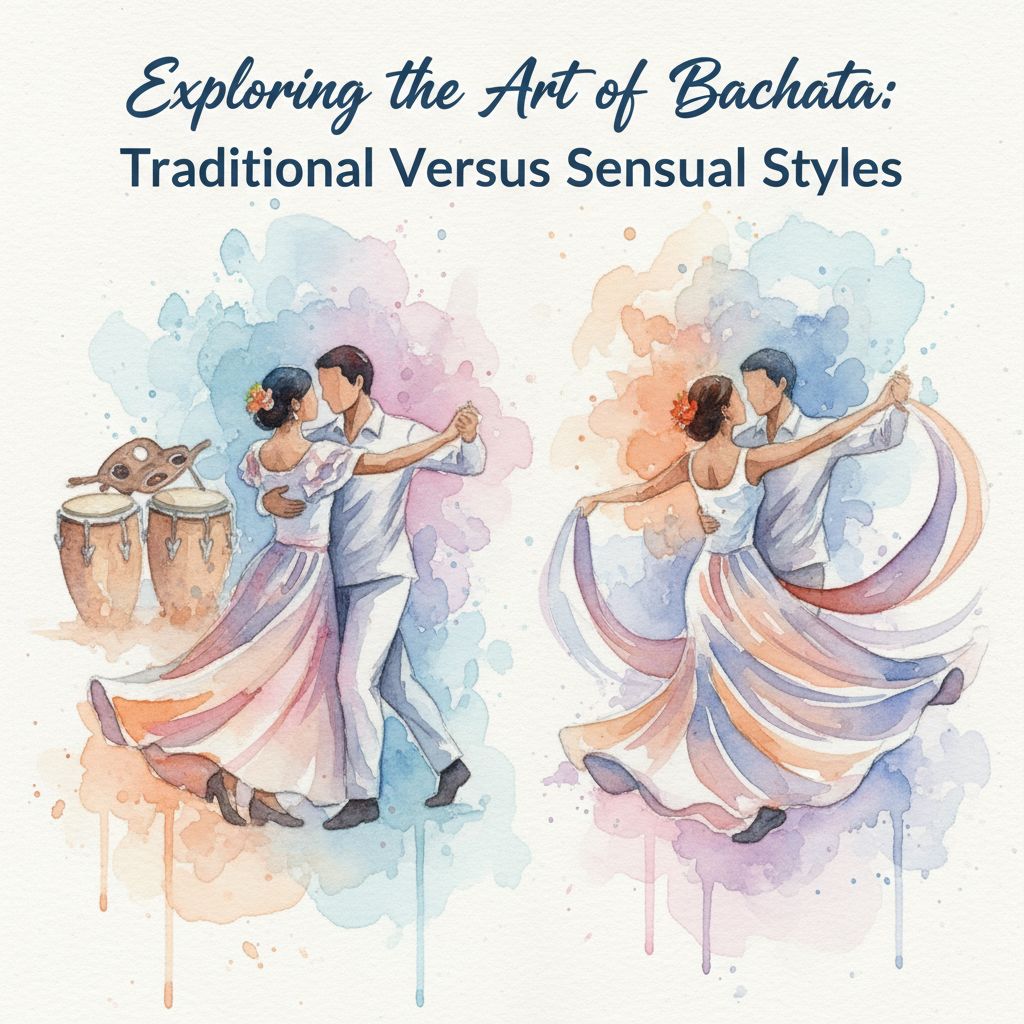
There are three main types of bachata. Dominican (traditional) bachata comes from the Dominican Republic and is playful and footwork-driven. Bachata moderna is a studio style built on side-to-side steps and turn patterns. Sensual bachata, developed in Cádiz, Spain, in the 2000s, swaps fancy footwork for body waves, isolations and a close, elastic connection.
All three share the same musical foundation: an eight-count phrase danced as three steps and a tap (or hip accent) on 4 and 8. What changes is the hold, how much the feet do, how the leader shapes the dance, and which music the style prefers.
If you came here because of the online arguments, start with our community digest on why so many dancers say they hate bachata sensual. It covers the criticisms, the defenses, and how to avoid the problems people complain about. This guide is the calmer overview: what each style is, where it came from, and how to pick one.
What are the main types of bachata?
The table below compares the three styles you will meet most often. Labels are used loosely in real scenes, and many dancers mix all three in one song, so treat this as a map rather than a rulebook.
| Dominican (traditional) | Bachata moderna | Sensual bachata | |
|---|---|---|---|
| Origin | Dominican Republic, social dancing from the 1960s onward | Dance schools outside the Dominican Republic, late 1990s | Cádiz, Spain; credited to Korke Escalona and Judith Cordero (academy dates it to 2004) |
| Music it favors | Guitar-driven bachata: requinto, segunda, bass, bongo, güira | Most modern bachata, including romantic pop bachata | Slower songs and remixes with synths, R&B or pop vocals |
| Tempo feel | Often fast and syncopated, but also danced slowly | Medium; adapts to the song | Slower; movements stretched across several counts |
| Hold and frame | Close embrace or open/semi-closed, with room to play with footwork | Open and closed positions; ballroom-style frame and dips | Close, torso-to-torso connection that stretches and returns |
| Footwork | The star: syncopations, taps, quick direction changes | Simpler footwork; some schools add “footwork” sections | Secondary to body movement |
| Typical moves | Basic steps in place, playful footwork “conversations”, short separations | Turn patterns, wraps, cross-body leads, dips | Body waves, isolations, head movement, circular figures, dips |
| How it is led | Loose and improvised; both partners have freedom | Pattern-based, structured partnerwork | Strict lead and follow through the body |
| Where you see it | Family gatherings and socials in the Dominican Republic; Dominican-focused nights and workshops abroad | Classes and socials worldwide | Many bachata festivals and socials, especially in Europe |
Sources for the table: Wikipedia’s Bachata (dance) article, SalsaVida’s overview of the different styles of bachata dancing, and a dance school’s traditional vs sensual bachata comparison.
What is Dominican bachata?
Dominican bachata is the original social dance. It grew up alongside the music in the Dominican Republic and was first danced in a closed, bolero-like embrace. The earliest basic step was a small box (side, side, forward, tap; side, side, back, tap). Over time it gained the side-to-side basic, the tap on 4 and 8, and plenty of syncopation. When UNESCO added the music and dance of Dominican bachata to its Intangible Cultural Heritage list in 2019, it described a couple’s dance with a sensual hip movement and a simple eight-step structure that many Dominicans learn informally from a young age.
What makes the style feel “Dominican” to most dancers:
- Footwork that answers the music. Dancers react to the guitar (the requinto), the bongo and the güira, adding taps, doubles and quick direction changes.
- Freedom inside the connection. Both partners can improvise footwork while staying connected, so the dance can look like a playful conversation. People coming from pattern-based classes often find this confusing at first, because there is no fixed sequence to memorize.
- A grounded, bouncy feel. Knees stay soft and the movement comes from the legs and hips rather than from big upper-body shapes.
Community discussions add a few useful observations. Dominican bachata is often called “simple”, but many dancers find it harder than it looks, because it rewards musicality and footwork control more than memorized combinations. It is also not always fast. It is just as often danced slowly, close and romantically. When followers trained mainly in sensual classes hesitate to try it, the usual reasons are unfamiliarity and the idea that it will be exhausting, not the dance itself.
How do people learn it outside the Dominican Republic? The common advice is to combine three things: a Dominican-focused class or workshop for partner work, solo footwork tutorials for vocabulary, and social dancing to traditional bachata so the footwork starts to follow the music rather than a routine.
What is bachata moderna?
Bachata moderna is the first style that dance schools outside the Dominican Republic built for bachata music. It appeared in the late 1990s and is still one of the most commonly taught forms worldwide. It keeps the 1-2-3-tap timing but uses a side-to-side basic instead of the box, adds a small hip “pop” on the tap, and borrows heavily from salsa and ballroom: cross-body leads, turn patterns, wraps and dips.
Compared with Dominican bachata, moderna is more structured. The leader runs patterns, and the follower’s job is mostly to follow them cleanly. Compared with sensual bachata, it uses fewer waves and less torso-led movement. Many teachers now add a “footwork” component taken from the Dominican style, which is why moderna and footwork are often discussed together.
A recurring social-dance question is whether followers get put off by too much moderna or footwork. Our article on bachata moderna and footwork at socials collects the community answers. The short version: execution and musicality matter more than style, and good leaders adapt to the song and to their partner.
What is sensual bachata?
Sensual bachata was developed in Cádiz, Spain, by Korke Escalona and Judith Cordero. Their academy dates the style to 2004, and SalsaVida’s history of bachata repeats that date. According to Wikipedia, Korke learned basic bachata in 1998 and built the style by merging bachata dynamics with Brazilian zouk, inspired in part by Juan Luis Guerra’s softer songs. That zouk influence explains the signature body waves.
Its main features:
- Body movement over footwork. Waves, isolations of chest, hips and head, and circular figures.
- Close, elastic connection. Partners stay close and communicate subtle leads through the torso. Some figures stretch the connection outward and then return.
- Strict lead and follow. Because many moves involve the follower’s balance, head or spine, the style depends on clear, safe leading.
- Slower, atmospheric music. Remixes and slower songs with synths and R&B or pop vocals suit the stretched-out movements best.
Sensual bachata spread quickly through the European festival circuit and is now taught worldwide. It also attracts the most criticism of any bachata style. Dancers object to unwanted closeness, badly led head movements, moves that ignore the music, and the distance from Dominican roots. The full debate is in why so many dancers say they hate bachata sensual. For a neutral definition, read what sensual bachata is and how it is danced. If you are nervous about learning it, start with sensual bachata for beginners.
What about bachata fusion, Influence, ConRi and bachazouk?
Beyond the big three, you will see a growing list of labels.
- Bachata fusion is the broadest one. It can mean bachata mixed with another dance (hip-hop, contemporary, tango), or simply mixing Dominican footwork, moderna patterns and sensual movement in one dance.
- Bachazouk (sometimes “zoukchata”) mixes bachata with Brazilian zouk and its flowing head and torso movement. Many dancers treat it as a separate dance rather than a bachata style. Our piece on zouk influence in bachata looks at whether zouk elements are making bachata look the same everywhere.
- Bachatango adds tango-inspired lines, pauses and turns. It is a niche fusion.
- Branded sub-styles such as Bachata Influence and ConRi are named methods taught within the sensual scene, usually by the instructors who created them. See Bachata Influence vs ConRi for how dancers describe the difference.
Many dancers are skeptical of new labels and see some of them as marketing. A useful test is whether a label changes how you dance (timing, connection, movement vocabulary) or only what a workshop is called.
Where did bachata come from?
Bachata began in the Dominican Republic as guitar music of the rural poor and the urban barrios. According to Wikipedia’s Bachata (music) article, the first recognized recording was José Manuel Calderón’s “Borracho de amor” in 1962. For decades the genre was looked down on: it was called amargue (“bitterness”) for its heartbreak lyrics and was associated with bars and brothels. Radio Guarachita, which programmed bachata from the mid-1960s, kept it alive.
The sound changed in the 1980s, when Blas Durán introduced the electric lead guitar. In 1990, Juan Luis Guerra’s album Bachata Rosa brought a polished, romantic bachata to mainstream audiences and later won a Grammy. In the 2000s, Aventura and its lead singer Romeo Santos mixed bachata with R&B and hip-hop and took it global. On the dance side, moderna appeared in Western dance schools in the late 1990s and sensual bachata in Spain in the 2000s. In 2019, UNESCO recognized Dominican bachata music and dance as Intangible Cultural Heritage.
Read the full timeline, including the “who invented bachata” question, in our history of bachata music and dance.
Sensual vs Dominican bachata: which should you learn?
There is no “correct” style, but there is usually a right first choice for you. Use this checklist:
- Learn what your local scene dances. If the socials near you are mostly sensual, sensual classes will give you the most partners. If they play lots of traditional bachata, Dominican footwork will pay off immediately.
- Start with the basic either way. Every style uses the same 1-2-3-tap timing. Being able to hear the 1 and keep a relaxed basic matters more than any style label.
- Choose Dominican if you love the guitar-driven sound, enjoy footwork, and like improvising more than memorizing patterns.
- Choose moderna if you want structured classes, turn patterns, and a style that works with almost any bachata song.
- Choose sensual if you enjoy body movement and close connection, and you are comfortable with (or curious about) isolations and waves. Only learn head movements from a teacher who covers safety.
- Plan to mix eventually. Many experienced dancers start a song with grounded Dominican steps and move into sensual figures when the music softens. Versatility is what makes you easy to dance with.
Is one style better than the others? Community discussions keep returning to the same answer: no. Most dancers describe a preference for either “smooth and silky” dancing (slow body rolls, breath, close connection) or “quick and playful” dancing (footwork, energy, lighter connection). That preference often follows their background: dancers who started with salsa, for example, often gravitate toward the energetic side. The preference can also change with the song, your mood, or the partner in front of you.
What if your partner learned a different style?
This happens constantly at socials: a moderna leader dances with a sensual follower, or a Dominican-trained follower meets a pattern-heavy leader. The community advice is consistent.
- Keep your fundamentals. Timing, posture and a clear basic are the shared language between schools.
- Adapt to the partner, not just the song. If a follower stiffens during waves, switch to footwork or open turns. If a leader keeps it simple, enjoy the basic instead of forcing styling.
- Ask about sensual moves. Many followers who prefer traditional or moderna simply say “no waves or head rolls, please” before the dance. Leaders should take that at face value.
- Treat the difference as a learning opportunity. Dancing with people from other schools is how most dancers discover what they like.
How can you tell which style a song calls for?
Listen to the instruments first. A busy requinto guitar, a driving bongo and a scraping güira invite Dominican footwork. A slow remix with synth pads, a heavy bass and long sustained notes invites sensual body movement. A mid-tempo romantic bachata with a clear beat works well for moderna patterns. Many songs change character between sections, so the most musical dancers change style with them. They stay grounded in the verses and use bigger figures where the music opens up.
Guides in this series
- Why so many dancers say they hate bachata sensual: the criticisms, the defenses and the etiquette fixes.
- What sensual bachata is and how it is danced: definition, music and technique basics.
- Sensual bachata for beginners: how to get comfortable with waves, isolations and close connection.
- The history of bachata music and dance: where bachata originated and who shaped it.
- Bachata moderna and footwork at socials: what moderna is and whether followers mind lots of footwork.
- Zouk influence in bachata: is bachata starting to look the same everywhere?
- Bachata Influence vs ConRi: two branded sensual sub-styles compared.
Related guides
- Bachata for beginners: the complete guide
- How to do the bachata basic step
- Bachata music, artists and songs
- Leading and following in bachata
FAQ
Is sensual bachata the same as Dominican bachata?
No. Both use bachata music and the 1-2-3-tap timing, but Dominican bachata centers on footwork and improvisation, while sensual bachata centers on body waves, isolations and a close, strictly led connection. Sensual bachata was developed in Spain decades after the Dominican dance.
Which bachata style is easiest for beginners?
Most beginners start with a moderna-style basic (side to side with a tap) because it is what most schools teach first. The easiest style to learn is the one your local classes and socials actually dance.
Where was sensual bachata created?
In Cádiz, Spain. It is credited to Korke Escalona and Judith Cordero, and their academy dates it to 2004.
Is bachata moderna the same as bachata fusion?
Not exactly. Moderna is a specific studio style from the late 1990s. “Fusion” is a broader label for bachata mixed with other dances or with several bachata styles at once. Some schools use the terms interchangeably.
Do you have to dance sensual moves at a social?
No. You can dance bachata socially with only basics, footwork and turns. Many followers ask for no waves or head rolls, and many leaders skip sensual figures with partners they don’t know. Good social dancing is about connection and musicality, not about a particular move set.