Where Did Bachata Originate? A Short History of Bachata Music and Dance
Part of: Bachata Styles Explained: Dominican vs Moderna vs Sensual
Bachata originated in the Dominican Republic, among rural and working-class communities, and took shape as a recorded genre in the 1960s. It grew out of the guitar bolero, mixed with son, cha-cha-chá and merengue. The first recognized bachata recording is José Manuel Calderón’s “Borracho de amor” (1962). The partner dance grew up alongside the music.
The history explains a lot about today’s bachata styles, from Dominican footwork to the sensual style developed in Spain. For how those styles compare, see our guide to the main bachata styles. Below is a short history of the music and the dance, checked against Wikipedia’s bachata music article, SalsaVida’s history of bachata and UNESCO’s entry for Dominican bachata.
Where is bachata from?
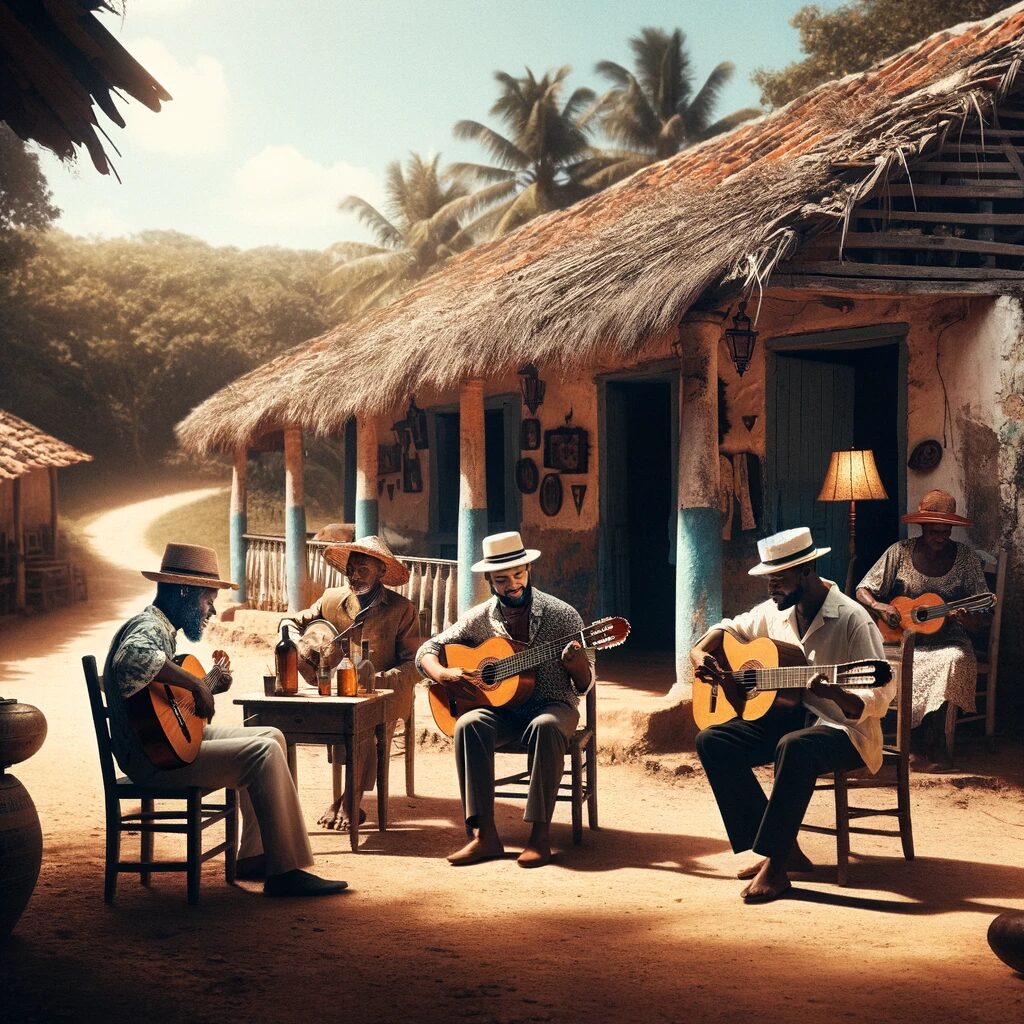
Bachata comes from the Dominican Republic. UNESCO describes the music as a fusion of rhythmic bolero with other Afro-Antillean genres such as son, cha-cha-chá and merengue. It was traditionally played by a small group with one or two lead guitars, bongos, maracas or güiro, and bass. The genre took shape in the countryside and in poor urban neighborhoods, where people sang about love, heartbreak and everyday hardship.
The word itself is older than the genre. “Bachata” first meant an informal party or lively get-together; UNESCO says the word is presumed to be of African origin. The music was also called amargue (“bitterness”), after the heartbroken mood of many songs.
Who invented bachata?
No single person invented bachata. It grew out of many guitarists and singers adapting bolero and other Caribbean styles. The name most often linked to its start is José Manuel Calderón, whose 1962 recordings “Borracho de amor” and “Qué será de mí (Condena)” are widely treated as the first bachata records.
When was bachata created, and how did it develop?
| Period | What happened |
|---|---|
| Before 1960 | Guitar-based bolero and rural party music circulate in the Dominican Republic. Wikipedia notes the music was censored and stigmatized under the Trujillo dictatorship, which ended in 1961. |
| 1962 | José Manuel Calderón records “Borracho de amor,” regarded as the first bachata recording. |
| Mid-1960s on | Radio Guarachita, run by Radhamés Aracena, becomes the main station playing bachata and helps the genre spread nationwide. |
| 1960s–1980s | Bachata is played in bars and brothels and dismissed by the middle and upper classes as low-status música cachivache (“junk music”). |
| 1980s | The güira replaces maracas. Blas Durán introduces electric lead guitar, faster tempos and multitrack recording; his “Mujeres hembras” (1987) is cited as the first bachata recorded with electric guitar. |
| 1990 | Juan Luis Guerra’s album Bachata Rosa (released 11 December 1990) gives the genre a polished, romantic sound. It wins the Grammy for Best Tropical Latin Album in 1992 (Wikipedia). |
| Early 1990s | Luis Vargas and Antony Santos lead the Dominican bachata scene. Electric steel-string guitars replace nylon strings. |
| Late 1990s–2000s | Dance schools outside the Dominican Republic develop bachata moderna. Bachata sensual is created in Cádiz, Spain (its academy dates it to 2004). |
| 2002 | Aventura, a Dominican-American group from the Bronx, releases We Broke the Rules with the hit “Obsesión,” mixing bachata with R&B and hip-hop. |
| 2000s–2010s | Aventura, led by Anthony “Romeo” Santos, sells out Madison Square Garden. Artists such as Prince Royce blend bachata with Western pop, and Romeo Santos launches a solo career. |
| 2019 | UNESCO inscribes the music and dance of Dominican bachata on its list of Intangible Cultural Heritage. |
A note on the two Santoses, since they are often mixed up: Antony Santos was one of the biggest bachata singers of the early 1990s. Romeo Santos (Anthony “Romeo” Santos) is the former lead singer of Aventura and later a solo star.
Why was bachata looked down on for so long?
Bachata’s low status was about class rather than music. It was the sound of poor rural migrants and the bars and brothels where they socialized. Many in the middle and upper classes considered its lyrics vulgar. Merengue, by contrast, enjoyed official prestige. For decades bachata had little radio play outside a few stations such as Radio Guarachita and was rarely heard in respectable venues.
The turnaround came in two waves. First, artists like Blas Durán, Luis Vargas and Antony Santos modernized the sound in the 1980s and early 1990s. Second, Bachata Rosa brought the genre to middle-class and international audiences. Aventura and Romeo Santos later made it a mainstream pop genre in the United States and Latin America. Bachata went from stigmatized to Grammy-winning to UNESCO-listed in under six decades.
How did bachata dance evolve?
The dance grew up with the music. According to Wikipedia’s bachata dance article, the original social dance was danced in a closed, bolero-like hold, often in a close embrace. Its basic step was a small box pattern: side, side, forward, tap; side, side, back, tap.
Over time the familiar side-to-side basic took over: three steps and a tap or hip movement on the fourth beat, repeated in the other direction. In the Dominican Republic the dance developed playful, syncopated footwork and quick changes of position. Today this is what dancers abroad call Dominican or traditional bachata.
As bachata spread internationally, dance schools began to systematize it:
- Bachata moderna appeared in Western dance schools in the late 1990s. It used a side-to-side basic, turn patterns and ballroom-style dips, and borrowed partnerwork ideas from salsa.
- Bachata sensual was developed in Cádiz, Spain, by Korke Escalona and Judith Cordero. It added body waves, isolations and circular movement influenced by Brazilian zouk.
- Fusion labels such as bachata fusion, bachazouk and others mix bachata with hip-hop, tango, zouk and more.
What has changed in the bachata scene in recent years?
Recent history is less documented, but dancers who have been in the international scene for a decade or more describe a fairly consistent arc in community discussions:
- The remix era. In the 2010s, remix DJs such as DJ Tronky made pop and R&B covers the default soundtrack in many sensual scenes, and sensual classes spread quickly. Some longtime dancers felt the dance lost touch with Dominican music at this point.
- Headrolls and body waves everywhere. Many classes centered on headrolls and waves, sometimes taught with questionable technique. Some leads barely moved their feet for much of a song.
- A calmer, zouk-influenced lead. More recently, many dancers describe a smoother way of leading influenced by Brazilian zouk, with fewer extreme head movements and more attention to accents, styling and musicality.
- A return to bachata music. Remixes are less dominant in many scenes. More modern Dominican-style bachata is played, and Dominican footwork classes have grown.
Several dancers summed up the result the same way: “bachata” has become an umbrella term for almost any partner dance that starts with 1, 2, 3, tap. For a closer look at how zouk shaped modern bachata, read whether zouk elements are making bachata look the same.
How is bachata danced around the world today?
Bachata is now one of the most popular social dances worldwide, with classes, weekly socials and festivals across Europe, the Americas and Asia. Dominican, moderna and sensual styles often share the same floor, and many social dancers mix all three depending on the song. Meanwhile, in the Dominican Republic people still dance bachata socially at family gatherings and parties, often learning it informally as children, as UNESCO notes.
FAQ
Where did bachata originate?
In the Dominican Republic, in rural areas and working-class neighborhoods. The genre took recognizable shape in the 1960s.
Who invented bachata?
No single person invented it. José Manuel Calderón is credited with the first bachata recordings, “Borracho de amor” and “Qué será de mí (Condena),” in 1962.
When was bachata created?
Its roots go back to the guitar music of the mid-20th century. As a recorded genre, bachata dates from 1962.
What does the word “bachata” mean?
It originally meant an informal party or get-together. UNESCO notes that the word is presumed to be of African origin.
What instruments are used in bachata?
A typical group has a requinto (lead guitar), segunda (rhythm guitar), bass guitar, bongos and güira. Maracas were common in the early years.
Is bachata sensual from the Dominican Republic?
No. The music and the original dance are Dominican, but the sensual style was developed in Spain in the 2000s.